
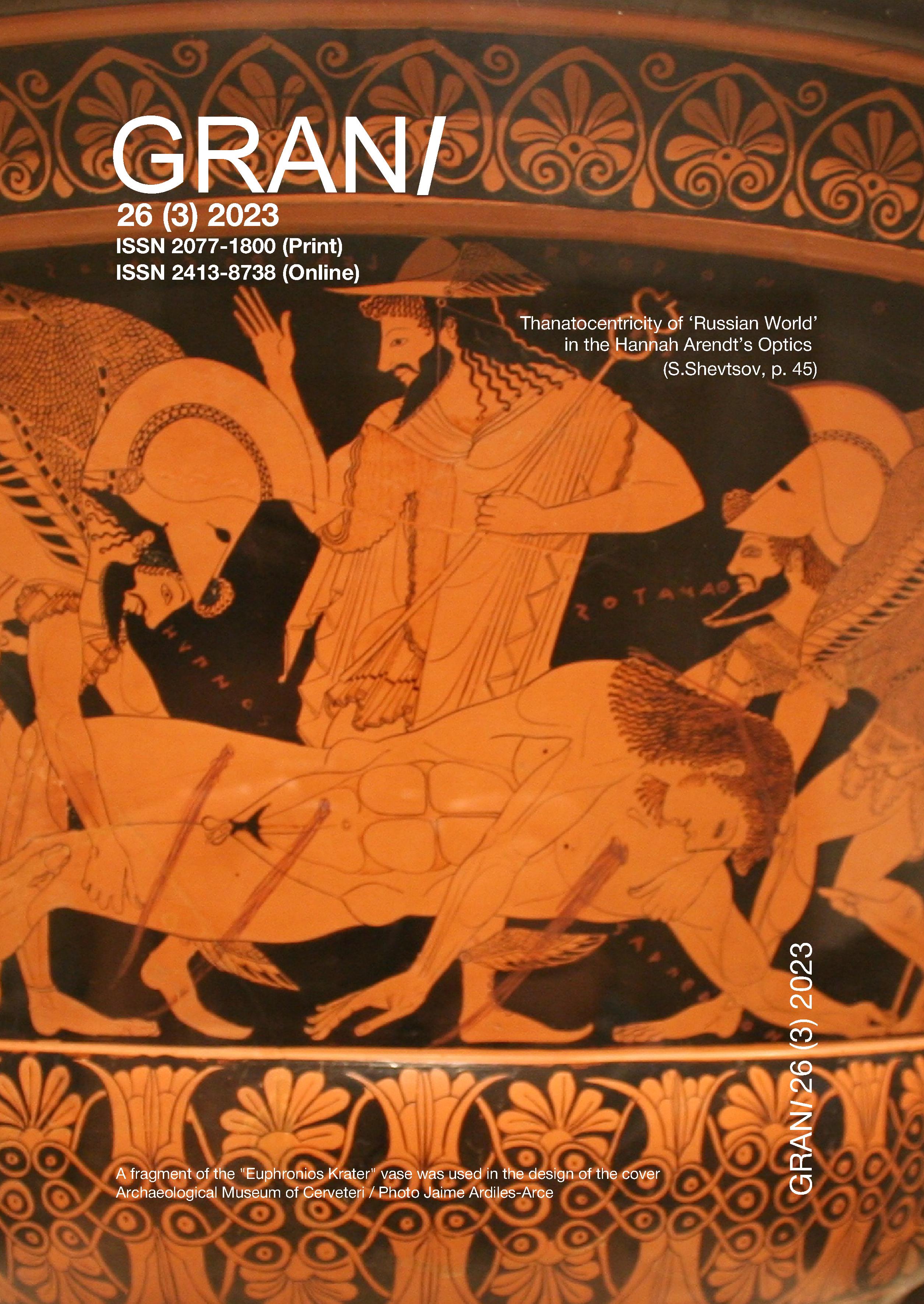
Танатоцентричність «русского мира» в оптиці ідей Ханни Арендт
DOI:
https://doi.org/10.15421/172347Ключові слова:
імперіалізм, ресентимент, маса, ідеологія, пропаганда, практика, суб’єктністьАнотація
Актуальність теми обумовлена тими цивілізаційними викликами з якими Україна зіштовхнулась у результаті повномасштабної російської навали з 24 лютого 2022 р., а також необхідністю осягнення світоглядних підвалин тривалої війни між Україною та Росією. Метою є артикуляція ознак танатоцентричності «русского мира» крізь призму ідей Х. Арендт, яка була однією з перших дослідниць феномену тоталітаризму. Результатами дослідження є, по-перше, позначення двох полюсів концепту «русский мир» – технократичний, представлений поглядами російських методологів (П. Щедровицький та ін.), де «русский мир» – мережева структура великих та малих спільнот, які мислять та розмовляють російською мовою, та релігійно-міфологічний (О. Дугін), де «русский мир» – месіанська ідея осередку боротьби телурократичного антиглобалізму та таласократичного глобалізму. По-друге, окреслення імплементативних механізмів втілення «русского мира», де технократичний полюс представлений помірно-бюрократичними пропозиціями С. Переслегіна та С. Градіровського, а релігійно-міфологічний – радикально-бюрократичними пропозиціями Т. Сергійцева. По-третє, показаний імперіалізм у світоглядному (силове підкорення інших), антропологічному (людина-чиновник як носій певних цінностей та смислів), політичному (боротьба з інакомисленням) аспектах. По-четверте, розглянутий ресентимент як неповноцінність, що зведена у систему моралі. По-п’яте, артикульований феномен маси як наслідок тотальної десуб’єктивації та деаксіологізації населення. По-шосте, окреслені грані ідеології як прояву інструменталізації культури. По-сьоме, з’ясована пропаганда як вагомий важіль впливу на свідомість громадян, примушуючи її функціонувати у межах бінарних опозицій (ми / вони, свої / чужі тощо). По-восьме, позначені можливі варіанти застосування тоталітарних практик у межах «русского мира». У висновках наведено, що танатоцентричність «русского мира» обумовлена його деперсоналізованістю та зачарованістю смертю і тому його прояв у межах України – це онтоцид. Виходячи з цього, цивілізаційним викликом уявляється проблематика подолання десуб’єктності на персональному, міжособистісному, внутрішньо- та зовнішньополітичному рівнях.Завантаження
Дані завантаження ще не доступні.
Посилання
Arendt, H. (2005). The Origins of Totalitarianism. Kyiv.
Blyndaruk, S. (2023). Anatomy of the Russian-Ukrainian Conflict (2014–2022) in the Era of Hybrid Wars. Retrieved from http://www.nbuv.gov.ua/node/5937
Bystrytsky, Ye., & Sytnichenko, L. (2022). Philosophy and Discourse of War: Conflict of Worlds as the Limit of Jurgen Habermas’ Communicative Theory. Філософська думка, 3, 64-82. DOI: https://doi.org/10.15407/fd2022.03.064
Datsyuk, S. (2015). Semantic War against Putin’s Russia. Hvylya Retrieved from https://hvylya.net/uk/analytics/61460-semanticheskaya-voyna-protiv-putinskoy-rossii
Dugin, A. (1999). The Andrey Platonov’s Magic Bolshevism. Retrieved from http://imperium.lenin.ru/LENIN/18/platonov.html
Dugin, A. (2014). Russia’s Eurasian Revenge. M.
Everything That Dewesternizes Us Kills Us, Interview with Vakhtang Kebuladze. (2023, March 6). Public TV. Retrieved from https://suspilne.media/403163-use-so-nas-devesternizue-nas-ubivae-intervu-z-filosofom-vahtangom-kebuladze/
Gay-Nyzhnyk, P. (Sci. Ed.) (2016). Russia's Aggression against Ukraine: Historical Background and Modern Challenges. Kyiv.
Gorbulin, V. (2020). How to Defeat Russia in the War of the Future). Kyiv.
Guriev, S., & Treisman, D. (2023). Spin Dictators: The Changing Face of Tyranny in the 21st Century. Kyiv.
Habermas, J. (2022, April 28). Krieg und Empörung. Süddeutsche Zeitung. Retrieved from https://www.sueddeutsche.de/projekte/artikel/kultur/das-dilemma-des-westens-juergenhabermas-zum-krieg-in-der-ukraine-e068321/?reduced=true
How not to Lose the Post-War Future. Experience and Mistakes of Other Countries. (2023, April 24). Ukrainian Institute of the Future. Retrieved from https://uifuture.org/publications/yak-ne-vtratyty-pislyavoyenne-majbutnye-dosvid-ta-pomylky-inshyh-krayin/
Kulyk, O. (2022). How To Think about War in Ukraine? Grani, 25(6), 112-121. DOI: https://doi.org/10.15421/172277
Ortega-і-Gasset, H. (1965). The Revolt of the Masses. NYC.
Professional Discussion "Political, Economic and Structural Consequences of Russian Aggression for Ukraine and the World Community. The Task of Economic Recovery of Ukraine in the Post-War Period, Taking Into Account European Integration Priorities. (2023, April 25). Retrieved from https://razumkov.org.ua/novyny/fakhova-dyskusiia-politychni-ekonomichni-i-strukturni-naslidky-rosiiskoi-agresii-dlia-ukrainy-i-svitovoi-spilnoty-zavdannia-ekonomichnogo-vidnovlennia-ukrainy-u-povoiennyi-period-z-vrakhuvanniam-ievrointegratsiinykh-priorytetiv
Russian World: Implementation Mechanisms. Conversation between Sergei Gradirovsky and Sergei Pereslegin. Network Project of ‘Russian World’ Russian Archipelagos Retrieved from https://archipelag.ru/ru_mir/history/histori2003/machinery/
Sergejtsev, T. (2022, April 30). What Should Russia Do with Ukraine. AIA News. Retrieved from https://ria.ru/20220403/ukraina-1781469605.html
Shchedrovitsky, P. (2000). Russian World and Transnational Russian. Network Project of ‘Russian World’ Russian Archipelagos. Retrieved from https://archipelag.ru/ru_mir/history/history99-00/shedrovicky-transnatio/
Silant’eva-Papp, K. (2019). Historiography of Hybrid War against Ukraine: Points of View of Russian Researchers. Scientific Journal of Uzhgorod University. Series «History», 211-217. Retrieved from https://dspace.uzhnu.edu.ua/jspui/handle/lib/26287
The Vakhtang Kebuladze’s Essay ‘Could War Be Justified?’. (2023, February 27). Magazine Forbes Ukraine. Retrieved from https://forbes.ua/ru/lifestyle/chi-mozhe-viyna-buti-vipravdanoyu-voyuvati-dlya-lyudstva-prirodno-chi-neobkhidno-poyasnyue-filosof-vakhtang-kebuladze-27022023-11942
The Vladimir Yermolenko’s Essay ‘What Kind of Social Contract Do We Need. (2022, March 20). Magazine Forbes Ukraine. Retrieved from https://forbes.ua/ru/lifestyle/yaka-suspilna-ugoda-nam-potribna-filosof-volodimir-ermolenko-pro-te-yak-pobuduvati-novu-ukrainsku-derzhavu-20092022-7999
The War Didn’t even Begin in 2014, but the Russian Empire Had Just Emerged. Interview with Taras Lyutyj. (2022, October 25). Internet-Resource ‘Livyj bereg’. Retrieved from https:// lb.ua/culture/2022/10/25/533630_taras_lyutiy_viyna_pochalasya_navit.html
The War with Russia and the Growing Up of Ukraine. Debate between Serhii Datsyuk and Andrii Baumeister. (2022, December 4). Retrieved from https://www.youtube.com/watch?v=T_pYCiG5mNk
Ukraine of the Future Is Similar to Early America, Interview with Volodymyr Yermolenko. (2022, March 20). Magazine Forbes Ukraine. Retrieved from https://forbes.ua/ru/lifestyle/ukraina-maybutnogo-skhozha-na-rannyu-ameriku-filosof-volodimir-ermolenko-pro-te-yak-ukraintsi-zminyuyut-khid-istorii-ta-formuyut-vlasni-tsinnosti-21042022-5579
War and Philosophy. The Ideology of Scorched Earth. Conversation between Alexander Genis and Mikhail Epstein on Radio Svoboda. (2022, June 27). Retrieved from https://www.svoboda.org/a/voyna-i-filosofiya-mihail-epshteyn-ob-ideologii-vyzhzhennoy-zemli/31911748.html
Yampol’sky, M. (2014, October 6). In the Land of Victorious Ressentiment. Colta. Retrieved from https://www.colta.ru/articles/specials/4887-v-strane-pobedivshego-resentimenta
Yaremchuk, S., Dyiak, V., & Tushko, K. (2023). Problems of the Formation of Ukrainian Cultural Identity in the Conditions of War. Grani. 26(1), 105-111. DOI: https://doi.org/10.15421/172317
Yasna, I. (2021). Forms of Contemporary Public Philosophical Discourse. Part 1. Literature, Media, Dialogue, Education. Grani, 24(12), 94-105. DOI: https://doi.org/10.15421/1721124
Yasna, I. (2022). Forms of Contemporary Public Philosophical Discourse. Part 2. Expert Opinion, Practice, Therapy, Leisure. Grani, 25(3), 16-24. https://doi.org/10.15421/172231
Yermolenko, A. (2022). We Should not Negotiate, but Resist. Internet-Resource Gazeta.ua. Retrieved from https://gazeta.ua/articles/poglyad/_mayemo-ne-domovlyatisya-a-chiniti-opir-poglyad-anatoliya-ermolenka/1090979
Blyndaruk, S. (2023). Anatomy of the Russian-Ukrainian Conflict (2014–2022) in the Era of Hybrid Wars. Retrieved from http://www.nbuv.gov.ua/node/5937
Bystrytsky, Ye., & Sytnichenko, L. (2022). Philosophy and Discourse of War: Conflict of Worlds as the Limit of Jurgen Habermas’ Communicative Theory. Філософська думка, 3, 64-82. DOI: https://doi.org/10.15407/fd2022.03.064
Datsyuk, S. (2015). Semantic War against Putin’s Russia. Hvylya Retrieved from https://hvylya.net/uk/analytics/61460-semanticheskaya-voyna-protiv-putinskoy-rossii
Dugin, A. (1999). The Andrey Platonov’s Magic Bolshevism. Retrieved from http://imperium.lenin.ru/LENIN/18/platonov.html
Dugin, A. (2014). Russia’s Eurasian Revenge. M.
Everything That Dewesternizes Us Kills Us, Interview with Vakhtang Kebuladze. (2023, March 6). Public TV. Retrieved from https://suspilne.media/403163-use-so-nas-devesternizue-nas-ubivae-intervu-z-filosofom-vahtangom-kebuladze/
Gay-Nyzhnyk, P. (Sci. Ed.) (2016). Russia's Aggression against Ukraine: Historical Background and Modern Challenges. Kyiv.
Gorbulin, V. (2020). How to Defeat Russia in the War of the Future). Kyiv.
Guriev, S., & Treisman, D. (2023). Spin Dictators: The Changing Face of Tyranny in the 21st Century. Kyiv.
Habermas, J. (2022, April 28). Krieg und Empörung. Süddeutsche Zeitung. Retrieved from https://www.sueddeutsche.de/projekte/artikel/kultur/das-dilemma-des-westens-juergenhabermas-zum-krieg-in-der-ukraine-e068321/?reduced=true
How not to Lose the Post-War Future. Experience and Mistakes of Other Countries. (2023, April 24). Ukrainian Institute of the Future. Retrieved from https://uifuture.org/publications/yak-ne-vtratyty-pislyavoyenne-majbutnye-dosvid-ta-pomylky-inshyh-krayin/
Kulyk, O. (2022). How To Think about War in Ukraine? Grani, 25(6), 112-121. DOI: https://doi.org/10.15421/172277
Ortega-і-Gasset, H. (1965). The Revolt of the Masses. NYC.
Professional Discussion "Political, Economic and Structural Consequences of Russian Aggression for Ukraine and the World Community. The Task of Economic Recovery of Ukraine in the Post-War Period, Taking Into Account European Integration Priorities. (2023, April 25). Retrieved from https://razumkov.org.ua/novyny/fakhova-dyskusiia-politychni-ekonomichni-i-strukturni-naslidky-rosiiskoi-agresii-dlia-ukrainy-i-svitovoi-spilnoty-zavdannia-ekonomichnogo-vidnovlennia-ukrainy-u-povoiennyi-period-z-vrakhuvanniam-ievrointegratsiinykh-priorytetiv
Russian World: Implementation Mechanisms. Conversation between Sergei Gradirovsky and Sergei Pereslegin. Network Project of ‘Russian World’ Russian Archipelagos Retrieved from https://archipelag.ru/ru_mir/history/histori2003/machinery/
Sergejtsev, T. (2022, April 30). What Should Russia Do with Ukraine. AIA News. Retrieved from https://ria.ru/20220403/ukraina-1781469605.html
Shchedrovitsky, P. (2000). Russian World and Transnational Russian. Network Project of ‘Russian World’ Russian Archipelagos. Retrieved from https://archipelag.ru/ru_mir/history/history99-00/shedrovicky-transnatio/
Silant’eva-Papp, K. (2019). Historiography of Hybrid War against Ukraine: Points of View of Russian Researchers. Scientific Journal of Uzhgorod University. Series «History», 211-217. Retrieved from https://dspace.uzhnu.edu.ua/jspui/handle/lib/26287
The Vakhtang Kebuladze’s Essay ‘Could War Be Justified?’. (2023, February 27). Magazine Forbes Ukraine. Retrieved from https://forbes.ua/ru/lifestyle/chi-mozhe-viyna-buti-vipravdanoyu-voyuvati-dlya-lyudstva-prirodno-chi-neobkhidno-poyasnyue-filosof-vakhtang-kebuladze-27022023-11942
The Vladimir Yermolenko’s Essay ‘What Kind of Social Contract Do We Need. (2022, March 20). Magazine Forbes Ukraine. Retrieved from https://forbes.ua/ru/lifestyle/yaka-suspilna-ugoda-nam-potribna-filosof-volodimir-ermolenko-pro-te-yak-pobuduvati-novu-ukrainsku-derzhavu-20092022-7999
The War Didn’t even Begin in 2014, but the Russian Empire Had Just Emerged. Interview with Taras Lyutyj. (2022, October 25). Internet-Resource ‘Livyj bereg’. Retrieved from https:// lb.ua/culture/2022/10/25/533630_taras_lyutiy_viyna_pochalasya_navit.html
The War with Russia and the Growing Up of Ukraine. Debate between Serhii Datsyuk and Andrii Baumeister. (2022, December 4). Retrieved from https://www.youtube.com/watch?v=T_pYCiG5mNk
Ukraine of the Future Is Similar to Early America, Interview with Volodymyr Yermolenko. (2022, March 20). Magazine Forbes Ukraine. Retrieved from https://forbes.ua/ru/lifestyle/ukraina-maybutnogo-skhozha-na-rannyu-ameriku-filosof-volodimir-ermolenko-pro-te-yak-ukraintsi-zminyuyut-khid-istorii-ta-formuyut-vlasni-tsinnosti-21042022-5579
War and Philosophy. The Ideology of Scorched Earth. Conversation between Alexander Genis and Mikhail Epstein on Radio Svoboda. (2022, June 27). Retrieved from https://www.svoboda.org/a/voyna-i-filosofiya-mihail-epshteyn-ob-ideologii-vyzhzhennoy-zemli/31911748.html
Yampol’sky, M. (2014, October 6). In the Land of Victorious Ressentiment. Colta. Retrieved from https://www.colta.ru/articles/specials/4887-v-strane-pobedivshego-resentimenta
Yaremchuk, S., Dyiak, V., & Tushko, K. (2023). Problems of the Formation of Ukrainian Cultural Identity in the Conditions of War. Grani. 26(1), 105-111. DOI: https://doi.org/10.15421/172317
Yasna, I. (2021). Forms of Contemporary Public Philosophical Discourse. Part 1. Literature, Media, Dialogue, Education. Grani, 24(12), 94-105. DOI: https://doi.org/10.15421/1721124
Yasna, I. (2022). Forms of Contemporary Public Philosophical Discourse. Part 2. Expert Opinion, Practice, Therapy, Leisure. Grani, 25(3), 16-24. https://doi.org/10.15421/172231
Yermolenko, A. (2022). We Should not Negotiate, but Resist. Internet-Resource Gazeta.ua. Retrieved from https://gazeta.ua/articles/poglyad/_mayemo-ne-domovlyatisya-a-chiniti-opir-poglyad-anatoliya-ermolenka/1090979
##submission.downloads##
Опубліковано
2023-06-12
Як цитувати
Шевцов, С. (2023). Танатоцентричність «русского мира» в оптиці ідей Ханни Арендт. Науково-теоретичний альманах Грані, 26(3), 45–53. https://doi.org/10.15421/172347
Номер
Розділ
ФІЛОСОФІЯ


